

Enhancing Credit Infrastructure: APIIK 2024 Study on the Indonesian Credit Reporting Ecosystem
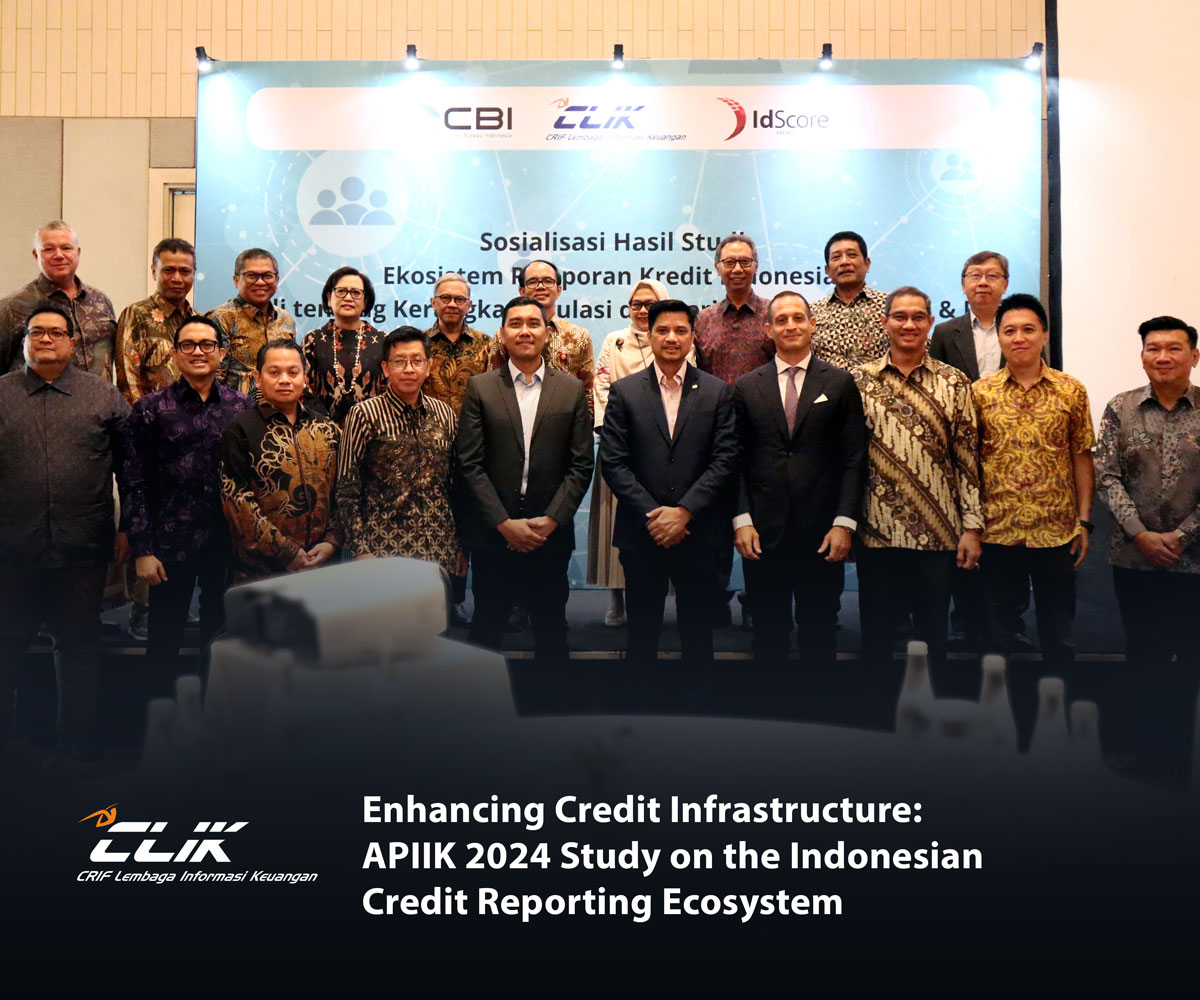
Jakarta, 2 September 2024 –Despite Indonesia’s high financial services adoption, with 85% of the population engaged in financial activities, the ratio of gross domestic product (GDP) to household debt remains relatively low at 16%. This is significantly lower than the average of 30% observed in countries such as India and the Philippines, highlighting a significant gap in the demand for larger loans with prime interest rates and inefficiencies in financial data utilization, and the need for improved creditworthiness evaluations.
Three LPIP Sees the Potential for Improved Credit Infrastructure and Establishes APIIK
In response to these challenges, three leading private credit bureaus (Lembaga Pengelola Informasi Perkreditan/LPIP) in Indonesia — PT CRIF Lembaga Informasi Keuangan (CLIK), PT Kredit Biro Indonesia Jaya (CBI), and PT PEFINDO Biro Kredit (idScore) — have come together to establish the Asosiasi Pengelola Informasi Kredit (APIIK). This strategic collaboration aims to enhance the country’s credit infrastructure, creating a more inclusive and efficient financial system.
To provide regulators and stakeholders with a comprehensive overview of the national credit infrastructure, APIIK partnered with EY Parthenon to conduct a study on Indonesia’s Credit Reporting Ecosystem. This study aims to understand the current performance and dynamics of Indonesia’s credit reporting sector, understand the global credit reporting industry, especially for the interaction between Public Credit Registry (PCR) and Private Credit Bureau (PCB), and identify potential considerations, gaps, and opportunities to improve credit assessment capabilities.
APIIK-EY Parthenon Report Recommends a Dual System Approach
The findings from the APIIK-EY Parthenon study were shared in a workshop with the Financial Services Authority (OJK) and other independent experts on July 30 in Jakarta. The report advocates for Indonesia to maintain a dual system archetype for its credit reporting infrastructure, where both the PCR and PCBs have distinct and complementary roles. In this approach, PCR (SLIK OJK) serves as a centralized database for data from financial institutions (FIs), while PCBs gather diverse data from non-financial institutions (Non-FIs) to produce detailed reports and credit scores that assess creditworthiness and spending behaviors. This approach aims to enhance the inclusion of the unbanked population, ensure robust risk assessment, maintain secure data privacy, and improve the overall efficiency and effectiveness of the credit reporting system.
EY-Parthenon Partner Anugrah Pratama added, “Adopting a dual system approach will address the current inefficiencies and significantly enhance the utilization of credit data. This change will in turn increase financial inclusivity and enable more accurate creditworthiness assessment, enhance financial access to MSME, support credit risk management, leading to better financial products for the Indonesian market.”
The Supervisory Chairman APIIK Rizana Noor pointed out that Indonesia still faces many challenges. “Continuous improvements in data-sharing infrastructure and access models are essential to provide fair and reliable data access for PCBs, as well as to develop secure data-sharing platforms that promote innovations,” he explained.
To embrace the transformation of Indonesia’s credit reporting system, APIIK is committed to collaborating with FI, Non-FIs, other data providers and regulators to support the adoption of the dual system. APIIK believes this innovation will drive a shift from financial inclusion to financial deepening, allowing financial institutions to offer a wider range of services and products to the public.
![[:id]Membangun Skor Kredit Lebih Baik: Tips Menggunakan Kartu Kredit yang Bertanggung Jawab[:en]Building a Better Credit Score: Essential Tips for Responsible Credit Card Use[:]](https://cbclik.com/wp-content/uploads/2024/08/Membangun-Skor-Kredit-Lebih-Baik-Tips-Menggunakan-Kartu-Kredit-yang-Bertanggung-Jawab-150x150.jpg?crop=1)
![[:id]Pentingnya Skor Kredit Untuk Jaga Daya Tahan Pertumbuhan Ekonomi [:en]The Importance of Credit Score to Maintain Economic Growth Resilience[:]](https://cbclik.com/wp-content/uploads/2024/09/Fortune-Photo-150x150.jpg?crop=1)