

SKAI Score 1.2: Purpose-Built Credit Scoring for BNPL and Small-Ticket Lending in Indonesia
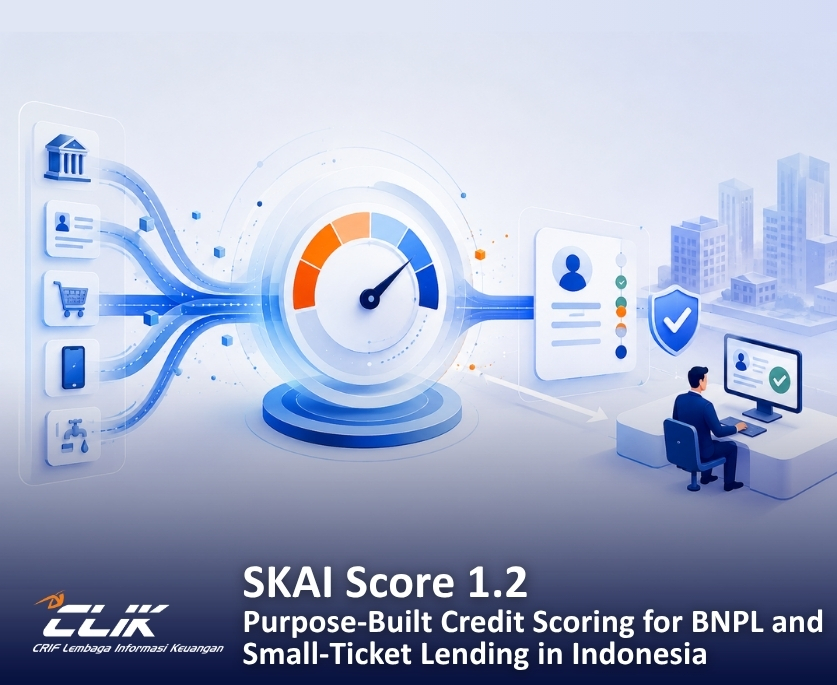
Indonesia’s lending landscape has shifted. BNPL and ultra-short-term financing now drive a large share of new credit originations — high volumes, small ticket sizes, and a need for instant underwriting decisions. Yet the risk infrastructure most institutions rely on was built for a different era: traditional, long-tenure loans and thick-file applicants.
To address this gap, CLIK developed SKAI, a probability-of-default credit score purpose-built for BNPL and small-ticket lending. Since its initial development, the model has been continuously refined using deeper portfolio insights and evolving borrower behaviour. SKAI Score 1.2 represents the latest evolution, expanding the range of loans it covers while introducing a more intelligent segmentation approach that enables sharper risk differentiation.
What Is SKAI 1.2 and How the Credit Score Works?
SKAI is CLIK’s probability-of-default credit score, purpose-built for BNPL and small-ticket lending in Indonesia. First introduced to address the unique risk characteristics of short-term, low-ticket loans, SKAI has since evolved to keep pace with the changing lending landscape.
SKAI 1.2 builds on the original model (SKAI 1.0) with broader product coverage and a smarter segmentation approach. While the initial version was designed for loans of up to IDR 8 million with tenures of up to six months, SKAI 1.2 now supports loans of up to IDR 10 million with tenures of up to 12 months. It also enhances risk assessment by incorporating borrowers’ credit profiles alongside repayment delinquency, allowing the model to distinguish risk more precisely.
Today, SKAI 1.2 predicts the probability of default for short-term, small-ticket loans, specifically contracts with a ticket size of up to IDR 10 million and a tenure of up to 12 months. It is purpose-built for BNPL and ultra-short-term lending, where repayment behavior, default timing, and borrower profiles differ fundamentally from those of conventional credit products.
SKAI 1.2 is designed at the application level. Rather than applying a single generic model to every applicant, SKAI 1.2 segments borrowers into three distinct populations based on both their repayment behaviour and credit profile over the previous 24 months. This enables the model to generate more accurate risk predictions for different types of borrowers.
- Dirty Segment
Applicants with at least one contract showing any days past due (even a single day) in the past 24 months. These borrowers carry observable repayment friction, and the model reads their delinquency patterns directly. - Clean Segment ≤ IDR 2 Million
Applicants with a perfect repayment record (zero days past due) and total disbursed amounts of IDR 2 million or less over the past 24 months. These are often newer credit users with limited exposure history. - Clean Segment > IDR 2 Million
Applicants with a perfect repayment record and total disbursed amounts above IDR 2 million. These borrowers have demonstrated both discipline and meaningful credit capacity.
Why Does Segmentation Matter?
A first-time BNPL user with a thin file and a seasoned borrower with a spotless multi-million-rupiah track record are not the same risk, even if both show “no delinquency.” A single blended model averages them out and misjudges both. Segment-specific models read each population on its own terms, producing sharper risk separation exactly where it matters most — at the approval margin.
How SKAI’s 1.2 Performance Is Validated?
A score is only as credible as the outcome definition behind it. SKAI is validated against two performance windows that mirror how short-term portfolios actually behave:
- Short-term outcome: whether a contract reaches 30+ days past due within the first three months of reporting. This captures early payment default — the dominant loss driver in BNPL portfolios.
- Long-term outcome: whether a contract reaches 60+ days past due within six months. This confirms that the score holds up beyond the first repayment cycle.
One refinement worth highlighting: SKAI applies a petty balance threshold of IDR 50,000. Contracts that technically default but carry an outstanding balance of IDR 50,000 or less are not tagged as bad events. This keeps trivial residual balances, a common artifact in small-ticket lending, from contaminating the definition of true default. The model learns from real losses, not administrative noise.
Where SKAI 1.2 Fits in Your Lending Workflow?
- Application decisioning — as the primary score or a complementary overlay for BNPL, paylater, and short-tenure cash loan applications.
- Limit management — initial limit assignment and periodic limit increases for existing small-ticket customers.
- Portfolio monitoring — re-scoring active customers to identify deteriorating segments before delinquency materializes.
- Champion–challenger testing — running SKAI alongside your incumbent score to quantify lift in approval rate, bad rate, or both, with real, measurable evidence before full deployment.
Why Small-Ticket Credit Scoring Matters Now?
Small-ticket lending is where Indonesian credit growth is happening — and where generic scores are weakest. Borrowers in this space are often young, thin-file, and behaviorally distinct from traditional bank customers. Institutions that keep assessing them with conventional tools face a quiet, compounding cost: good customers declined and lost to competitors, and bad customers approved on incomplete signals.
SKAI turns bureau data into a decision instrument built for exactly this market — segmented, validated against the outcomes that drive your losses, and designed for the speed and scale that short-term lending demands.
If your institution is active in BNPL or small-ticket financing, the next step is a champion-challenger test — running SKAI alongside your incumbent score to quantify the lift in approval volume and loss performance with real, measurable evidence. Contact CLIK to scope a pilot.
FAQ
What is SKAI 1.2?
SKAI is CLIK’s probability-of-default credit score, purpose-built for BNPL and small-ticket lending in Indonesia, covering loans up to IDR 10 million in ticket size and 12 months in tenure.
What’s the difference between SKAI 1.0 and SKAI 1.2?
✓ Expanded coverage from IDR 8M / 6 months to IDR 10M / 12 months
✓ Enhanced segmentation by combining delinquency and credit profile
✓ Improved risk differentiation for BNPL and small-ticket lending
Who is SKAI 1.2 for?
Risk and credit teams at BNPL providers, paylater platforms, multifinance companies, and short-tenure cash loan lenders operating in Indonesia.
How does SKAI 1.2 segment applicants?
SKAI groups applicants into three segments based on 24 months of credit behavior: Dirty Segment (any days past due), Clean Segment ≤ IDR 2 million disbursed, and Clean Segment > IDR 2 million disbursed.
How is SKAI’s 1.2 performance measured?
Against two outcome windows: a short-term outcome (30+ days past due within 3 months) and a long-term outcome (60+ days past due within 6 months).
What is the petty balance threshold in SKAI 1.2?
Contracts that default but carry an outstanding balance of IDR 50,000 or less are not tagged as bad events, so trivial residual balances don’t distort the default definition.
How can a lender evaluate SKAI 1.2 before adopting it?
Through a champion–challenger test — running SKAI alongside an incumbent score to measure the lift in approval rate and bad rate using real portfolio data.
![[:id]CLIK Perkenalkan Propensity Score, Bantu Lembaga Keuangan Tingkatkan Efektivitas Pemasaran Kredit[:en]CLIK Introduces Propensity Score to Help Financial Institutions Improve Credit Marketing Effectiveness[:]](https://cbclik.com/wp-content/uploads/2026/07/Website-pics-propensity-score-150x150.jpg?crop=1)
![[:id]Kenalan dengan CIKA, AI Assistant CLIK Biro Kredit[:en]Meet CIKA: CLIK Credit Bureau’s AI Assistant Is Ready[:]](https://cbclik.com/wp-content/uploads/2026/09/CIKA-Website-pic-150x150.jpg?crop=1)