

Find Your Next Borrower Before Your Competitor Does: Introducing the CLIK Propensity Score
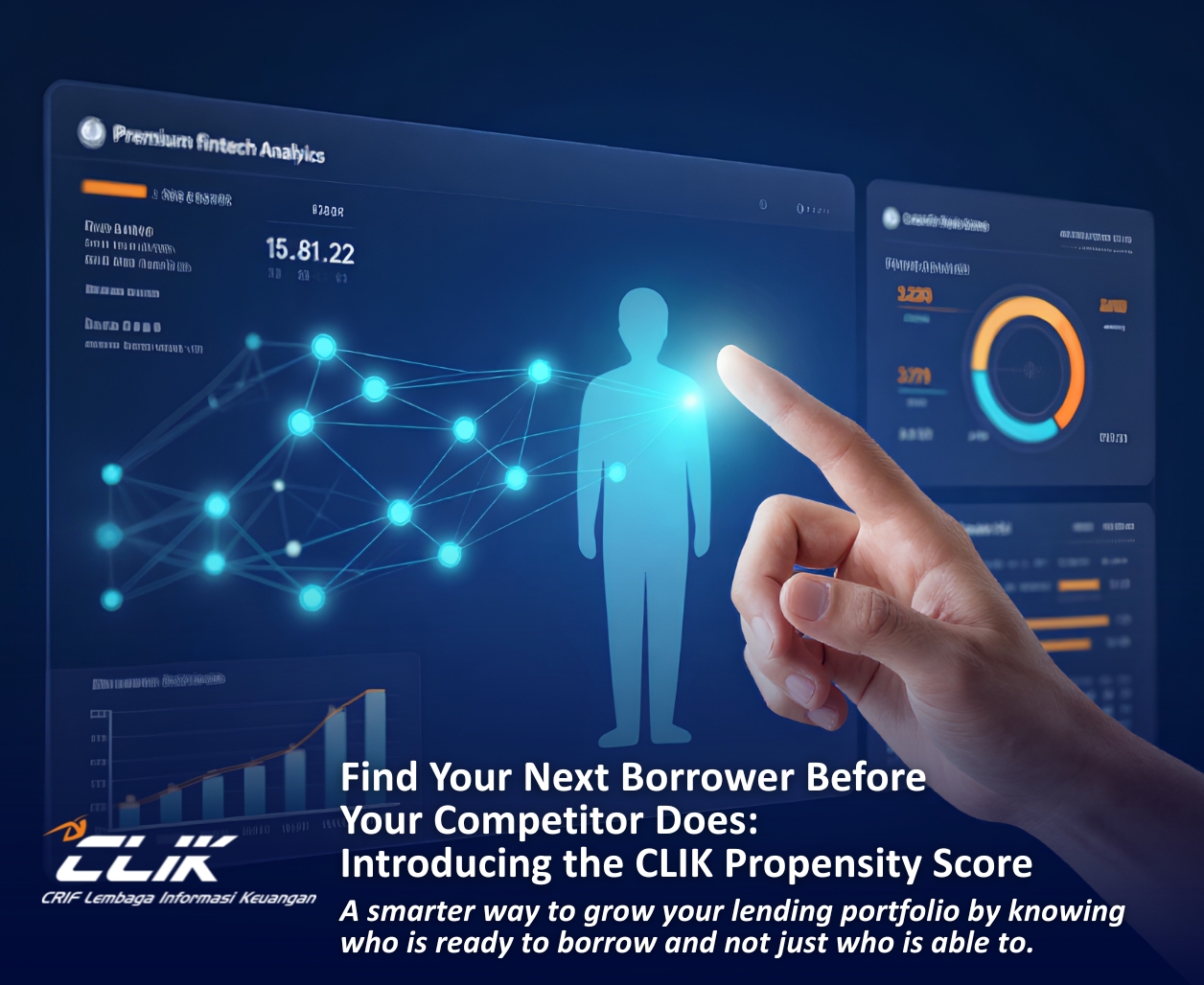
Have you ever wondered why some lenders seem to consistently win the cross-sell game by converting more customers from smaller campaigns, at a fraction of the cost? Can I really focus my budget only on customers most likely to take a loan without sacrificing portfolio quality? And crucially, how do I reach precision across millions of customers? Chances are, they use a propensity score to identify which customers are most likely to take a new loan, and target only them. In this article, we explain what a propensity score is, how it works, and why it matters for banks, multifinance companies, BNPL providers, and P2P platforms in Indonesia.
What is a propensity score?
A propensity score quantifies the probability that a customer will take a specific action in this case, taking a new unsecured loan within the next three months based on their past credit behavior and the behavior of similar borrowers. The CLIK Propensity Score is built on Indonesia’s credit bureau data, which captures how individuals borrow and repay across the financial system banks, multifinance, BNPL, and P2P lending, not just within a single institution. The model focuses on unsecured credit products: credit cards, cash loans, BNPL, and P2P loans, identified through collateral data, with a materiality threshold to ensure the score reflects meaningful credit events. In simple terms, from a given snapshot, the score answers one question for every customer in your portfolio “How likely is this person to take a new unsecured loan in the next 90 days?” A useful way to think about it, a propensity score is like a batting average. It will not be right on every single customer, but applied across thousands of customers, it consistently produces far better results than random selection.
The problem it solves most campaign budget is wasted on the wrong customers
Here is the uncomfortable truth behind most cross-sell campaigns, demand for credit is highly concentrated, but campaigns treat it as if it were evenly spread. Our analysis of the scorable bureau population shows just how concentrated it is. Customers who are actively managing multiple unsecured facilities account for the overwhelming majority of new unsecured loan take-up. Roughly 70% of all new loan events come from less than a third of the population. Meanwhile, customers with no recent unsecured activity convert only rarely. This means that in an untargeted campaign, most of your budget the SMS blasts, the telemarketing hours, the digital ad spend is spent talking to customers who were never going to borrow, while the customers who are ready to borrow may not hear from you at all. And because credit demand is time-bound, that silence has a cost, a customer who is ready to borrow in the next three months will borrow. The only question is from whom. There is one more blind spot. Your customer may have just opened a BNPL facility elsewhere or be steadily building unsecured usage across other providers with some of the strongest signals of borrowing appetite there are. But those signals are invisible in your internal data. They are only visible at the bureau level, across the whole financial system. That is why a bureau-built propensity score can see demand that even your best internal model cannot.
How is a propensity score different from a credit risk score?
This is the most common question we hear, and the distinction is simple:
- A credit risk score answers: “If this customer borrows, will they repay?” It measures ability and willingness to pay.
- A propensity score answers: “Will this customer borrow at all — and when?” It measures appetite and likelihood of take-up.
A customer can be perfectly creditworthy and still have no interest in a new loan — marketing to them wastes budget. Another customer may be eager to borrow but fall outside your risk appetite — lending to them creates losses. The real power comes from using both together: the risk score filters who you are willing to approve, and the propensity score ranks who is most likely to respond. The overlap — creditworthy customers with high propensity — is your ideal campaign target list. This is why the CLIK Propensity Score is designed around risk-worthy customers with solid historical repayment behavior: it helps you grow your portfolio without compromising its quality.
What does this look like in practice?
Consider a few common scenarios for Indonesian lenders:
- A bank growing its personal loan (KTA) portfolio. Instead of sending an offer to its entire payroll customer base, the bank scores the base with the propensity model and concentrates its telemarketing and digital campaigns on the highest-propensity segment. The result: fewer contacts, higher conversion, and a materially lower cost per booked loan.
- A multifinance company cross-selling cash loans. The company has thousands of customers who completed motorcycle financing with clean repayment records. The propensity score identifies which of these proven payers are actively in a borrowing phase right now — making them the right candidates for a cash loan offer this quarter, not next year.
- A BNPL or P2P platform deepening engagement. The platform identifies which existing users are most likely to expand their unsecured credit usage in the next 90 days, and prioritizes them for limit increases or new product offers — reaching them before they build that relationship with a competitor.
How does an engagement with CLIK work?
Putting the score to work is straightforward:
- We start with your objective. A cross-sell push, a credit card activation drive, a new BNPL product launch the campaign goal shapes how the score is applied.
- CLIK scores your customer base using the propensity model on the latest bureau snapshot, capturing each customer’s credit behavior across the entire financial system.
- You receive a ranked view of demand which customers are most likely to take a new unsecured loan in the next three months.
- You overlay your own criteria. Propensity tells you who will respond; your credit policy and risk appetite tell you who you want to approve. The intersection is your target list.
- You launch a focused campaign and measure the lift against your previous untargeted baseline.
The score is available through batch file delivery, through API for real-time digital journeys and on-demand decisioning, or both fitting the way your marketing and decisioning workflows already operate.
What makes a good propensity model?
Not all propensity models are created equal. Four elements matter most:
- Built on behavior, not assumptions. Demographics tell you who a customer is; credit behavior tells you what they actually do. The CLIK Propensity Score is built on demonstrated borrowing and repayment behavior across the entire bureau — the strongest available predictor of future credit demand.
- Focused on a meaningful outcome. The model predicts a concrete, commercially relevant event: taking a new unsecured loan above a materiality threshold within three months — keeping the score aligned with what your campaign actually needs to deliver: funded loans, not vague “interest.”
- Interpretable for stakeholders. A score no one understands is a score no one trusts. The model’s segmentation is built on intuitive drivers such as a customer’s recent unsecured borrowing activity making it easy to explain to marketing teams, risk committees, and management alike.
- Deployable in your workflow. A model is only useful if it reaches your campaign engine. File-based and API delivery mean the score fits both campaign cycles and real-time digital journeys.
The bottom line
In a market as dynamic as Indonesia’s — where BNPL is bringing millions of new borrowers into the system and competition for proven, creditworthy customers grows every quarter — the lenders who grow fastest are not the ones who shout the loudest. They are the ones who know who to talk to, and when. A propensity score will not guarantee that every targeted customer converts. But like a strong batting average, it reliably shifts the odds in your favor: higher conversion, lower acquisition cost, a better customer experience, and growth built on customers you already trust.
To learn more about the CLIK Propensity Score, request a sample analysis on your portfolio, or discuss a pilot, contact your CLIK Account Manager.
![[:id]Laporan Tahunan 2025: Pengungkapan Kondisi Keuangan dan Non Keuangan[:en]2025 Annual Report: Financial and Non-Financial Condition Disclosure[:]](https://cbclik.com/wp-content/uploads/2026/05/Your-paragraph-text-4-150x150.jpg?crop=1)
![[:id]CLIK Dukung Muhammadiyah Melalui Kontribusi Sosial dan Inklusi Keuangan [:en]CLIK Supports Muhammadiyah Through Social Contribution and Financial Inclusion [:]](https://cbclik.com/wp-content/uploads/2026/07/7-150x150.jpg?crop=1)